Saturday, September 1, 2012
Afiyet Olsun, Part 3: (Cunda Edition) Rakı Balık
A more traditional and refined example of the local seafood offerings were the many types of local fish that could be paired with a glass or three of Turkish rakı for a leisurely Rakı Balık dinner. This usually consists of a few shared appetizers like cucumber-tomato salad that precede the main course of a whole grilled fish and a shared bottle of rakı, the local anise-flavored liqueur (which will get it's own post soon enough). Since the meal consists of several courses it takes longer than some of the other offerings I'll describe, but it is a great excuse for a leisurely dinner at a seaside restaurant that can last for a couple hours at least. Ordering can be a bit confusing at times since the Turkish names for the fish used by the restaurants are unfamiliar to most people; the ones that I came across most often were Çipura (Gilthead seabream) and Levrek (European Seabass). Luckily, in my experience no matter what you order it's always delicious and well worth the price, which is higher than the papalina but still pretty reasonable. And since the rakı is served over ice it makes for a refreshing companion to the grilled fish and a great summer evening dinner. Just be careful not to try finishing the bottle on your own!
Afiyet Olsun, Part 2: (Cunda Edition) Papalina
One of the best things about being in Cunda for the summer was that I had easy access to all the great seafood that is part of living in the Turkish Aegean. The city's waterfront faces the exit from the harbor to the Aegean and fishing boats come and go all day bringing fresh catches into the city's restaurants. The first dish I tried this summer was called Papalina, which consisted of small fish resembling sardines that are deep-fried whole and eaten by the bowlful. When we first arrived they were described to us as the local equivalent of french fries, since they were available at every restaurant and were a great casual snack. At 10 YTL a bowl they also made for a nice, light meal between classes. It wasn't the most sophisticated offering available on the island but it did hit the spot for those times when we were out having a beer and looking for some great local food that wouldn't break the bank. And since it's apparently just a local specialty around Ayvalik and Cunda we had to take advantage of our chance to have it while we could.
Tuesday, August 28, 2012
Ottoman Summer School and Life in Cunda
I am back in Istanbul and back to blogging after a long hiatus in Cunda for my Intensive Ottoman Turkish Summer School. I hadn't planned on taking such a long break from the blog but the workload at the school didn't leave a lot of time or mental energy for writing about my experiences. Thankfully I was able to enjoy some downtime on the small Aegean island that became our home for a month and a half, but I hope you all understand why I was more likely to spend it on the beach or the soccer field than at the computer.
After a month in Istanbul getting settled into the new apartment and getting all my research permissions squared away, I went into my summer program feeling pretty confident that I could find my way around without many problems. It turns out there's nothing like a trip across Turkey without a set itinerary to shake your confidence a bit. I had bought a ticket on a ferryboat that would take me across the Sea of Marmara to the town of Bandirma on the advice that when I arrived there would be buses leaving regularly to Ayvalik, my final destination. The first leg went fine, but upon arrival in Bandirma I learned that the buses weren't running at that time and I would have to adjust my plans. Luckily, these kinds of adjustments are fairly easy to make in Turkey and a (relatively) short train, bus and taxi ride later I made it to my hotel in Cunda. The trip was longer than I expected but still enjoyable, since the train gave me a chance to relax and enjoy the scenery. I'm always amazed when traveling through the Turkish Aegean how much it reminds me of Northern California. There's something about the foothills and brown grass broken up by fields of corn, fruit trees, and vineyards that makes it feel a bit like home. Unfortunately, the pictures can't quite capture it but I'll put one up anyway.
I was one of the fortunate few in the program to have visited Cunda before this summer. When I was studying Turkish in Izmir in 2009 our group made two trips to Cunda to enjoy the boat trips that leave regularly from Cunda and its neighbor Ayvalik. The boat trips are a great experience, but since they were always part of a day trip from Izmir I had never spent more than an hour or so in Cunda at a time. It turns out there is more to the island than the series of fish restaurants that line the waterfront. The town itself is not large, mostly confined to four or five streets running parallel to the main waterfront, but it's filled with small restaurants, bars, and shops. The food was amazing and the locally produced liquor, even more so. It's a pretty typical little Aegean resort town that was big enough to have almost everything we needed during our stay but not so big that it was overwhelming. The program put us up at Kapya Apart Otel [http://kapya.com/index.php], a small hotel in the middle of town with air-conditioned rooms, a pool, and a comfortable, covered patio area. Given that almost all of the twenty or so students were housed there we occupied most of the rooms and it became like a private group house for all of us in the program. Though we had some complaints by the end of the five weeks, it sure beat any other student housing I've been in! We could gather every morning for buffet-style Turkish breakfast and we occupied the patio just about every night until at least midnight trying to puzzle through our Ottoman readings from the days classes. Luckily everyone seemed to get along and it turns out working in groups makes what can sometimes seem like an impossible language to understand be a bit more manageable.
The school itself is housed in a two-story building renovated to include classrooms, offices, a kitchen, and a patio, and is only a 3-4 minute walk away from the hotel. This was the 16th year that the program has offered intensive summer instruction in Ottoman Turkish and all the other linguistic odds and ends that one needs in order to understand Ottoman documents. It is unique in the kind of instruction that it offers and is indispensable for someone trying to learn this extremely difficult language before getting into the archives to do research. Founded by the late Harvard professor Şinasi Tekin, the school is run as a joint venture by Harvard and Koç University in Istanbul [http://ottomanstudiesfoundation.com/intensive-ottoman-and-turkish-summer-school/]. The lists of alumni that line a wall of the school are both impressive and intimidating since many of them are publishing some of the most interesting books coming out now in Ottoman History. It's a pretty high standard to hold yourself to, but it's somewhat encouraging at the same time. And for someone like me who doesn't have any other Ottoman history graduate students in my program, just getting the chance to meet other students working in the same field was a treat. It helped that they were all pretty great people in and out of the classroom and could make for some great drinking partners at future conferences.
In hindsight, it's a bit of a miracle that we got along as well as we did, given how strenuous our daily schedule was. We started our mornings with two and a half hours of Ottoman Turkish class where we cycled through a series of printed and hand-written Ottoman documents from the 19th century. While the hand-writing was pretty tough, trying to break down the complex grammar of documents that were often made up of a single, page-long sentence and then translate that into English often proved to be a bigger challenge. Since I started studying Modern Turkish, I had been told by various people that Ottoman was basically just Turkish written in the Arabic script with a few Arabic and Persian words mixed in. Unfortunately, this could not be more wrong. The basic structure of the language is Turkish, but it also mixes in a number of Arabic and Persian grammatical structures along with the smattering of foreign vocabulary and writes it all in a hand-written script that can often feel impossible to decipher. Then just for good measure, the documents will sometimes lapse into pure Arabic or Persian for lines and even pages at a time. To be able to read any document that comes your way, it's really best to be educated in the old Ottoman style and know Arabic and Persian in addition to old Turkish so you're prepared for whatever mix a particular writer throws in your direction. So, after our Ottoman courses finished for the day we got to attend a series of support courses to help us cobble together the linguistic knowledge we would need to help us decipher the Ottoman texts. Often, this meant that two and a half hours of reading Ottoman documents was followed up by an hour and a half of muddling through 10th century Persian poetry, about an hour off for lunch, and then another hour and a half of Modern Turkish reading and conversation. With classes from 9-3:30 conducted in three languages we were pretty exhausted by the time we got out. We would often spend a few hours napping or relaxing at the beach and then gather for homework sessions that lasted until at least midnight most nights. This was maybe the hardest part about the program. While we got to spend a month and a half on a beautiful little Aegean island in easy walking distance to the beach, most days we were too tired to take advantage of it.
That being said, we did find time to get out for at least one boat cruise around the islands and to enjoy the amazing food and liquor that the island had to offer. I'll put up some special posts on the food as the week goes by when I have a chance to write them up. All in all it was a pretty amazing summer and I feel much better prepared for my coming year in the archives. It is good to be back in Istanbul with Amanda and to get settled into a more normal routine. My return was perfectly times to enjoy some of the festivities marking the end of Ramadan so I'll put together a post with some of those pictures as well. For now, it's time to get all my immigration issues settled and start getting back to work on my own research.
After a month in Istanbul getting settled into the new apartment and getting all my research permissions squared away, I went into my summer program feeling pretty confident that I could find my way around without many problems. It turns out there's nothing like a trip across Turkey without a set itinerary to shake your confidence a bit. I had bought a ticket on a ferryboat that would take me across the Sea of Marmara to the town of Bandirma on the advice that when I arrived there would be buses leaving regularly to Ayvalik, my final destination. The first leg went fine, but upon arrival in Bandirma I learned that the buses weren't running at that time and I would have to adjust my plans. Luckily, these kinds of adjustments are fairly easy to make in Turkey and a (relatively) short train, bus and taxi ride later I made it to my hotel in Cunda. The trip was longer than I expected but still enjoyable, since the train gave me a chance to relax and enjoy the scenery. I'm always amazed when traveling through the Turkish Aegean how much it reminds me of Northern California. There's something about the foothills and brown grass broken up by fields of corn, fruit trees, and vineyards that makes it feel a bit like home. Unfortunately, the pictures can't quite capture it but I'll put one up anyway.
I was one of the fortunate few in the program to have visited Cunda before this summer. When I was studying Turkish in Izmir in 2009 our group made two trips to Cunda to enjoy the boat trips that leave regularly from Cunda and its neighbor Ayvalik. The boat trips are a great experience, but since they were always part of a day trip from Izmir I had never spent more than an hour or so in Cunda at a time. It turns out there is more to the island than the series of fish restaurants that line the waterfront. The town itself is not large, mostly confined to four or five streets running parallel to the main waterfront, but it's filled with small restaurants, bars, and shops. The food was amazing and the locally produced liquor, even more so. It's a pretty typical little Aegean resort town that was big enough to have almost everything we needed during our stay but not so big that it was overwhelming. The program put us up at Kapya Apart Otel [http://kapya.com/index.php], a small hotel in the middle of town with air-conditioned rooms, a pool, and a comfortable, covered patio area. Given that almost all of the twenty or so students were housed there we occupied most of the rooms and it became like a private group house for all of us in the program. Though we had some complaints by the end of the five weeks, it sure beat any other student housing I've been in! We could gather every morning for buffet-style Turkish breakfast and we occupied the patio just about every night until at least midnight trying to puzzle through our Ottoman readings from the days classes. Luckily everyone seemed to get along and it turns out working in groups makes what can sometimes seem like an impossible language to understand be a bit more manageable.
The school itself is housed in a two-story building renovated to include classrooms, offices, a kitchen, and a patio, and is only a 3-4 minute walk away from the hotel. This was the 16th year that the program has offered intensive summer instruction in Ottoman Turkish and all the other linguistic odds and ends that one needs in order to understand Ottoman documents. It is unique in the kind of instruction that it offers and is indispensable for someone trying to learn this extremely difficult language before getting into the archives to do research. Founded by the late Harvard professor Şinasi Tekin, the school is run as a joint venture by Harvard and Koç University in Istanbul [http://ottomanstudiesfoundation.com/intensive-ottoman-and-turkish-summer-school/]. The lists of alumni that line a wall of the school are both impressive and intimidating since many of them are publishing some of the most interesting books coming out now in Ottoman History. It's a pretty high standard to hold yourself to, but it's somewhat encouraging at the same time. And for someone like me who doesn't have any other Ottoman history graduate students in my program, just getting the chance to meet other students working in the same field was a treat. It helped that they were all pretty great people in and out of the classroom and could make for some great drinking partners at future conferences.
In hindsight, it's a bit of a miracle that we got along as well as we did, given how strenuous our daily schedule was. We started our mornings with two and a half hours of Ottoman Turkish class where we cycled through a series of printed and hand-written Ottoman documents from the 19th century. While the hand-writing was pretty tough, trying to break down the complex grammar of documents that were often made up of a single, page-long sentence and then translate that into English often proved to be a bigger challenge. Since I started studying Modern Turkish, I had been told by various people that Ottoman was basically just Turkish written in the Arabic script with a few Arabic and Persian words mixed in. Unfortunately, this could not be more wrong. The basic structure of the language is Turkish, but it also mixes in a number of Arabic and Persian grammatical structures along with the smattering of foreign vocabulary and writes it all in a hand-written script that can often feel impossible to decipher. Then just for good measure, the documents will sometimes lapse into pure Arabic or Persian for lines and even pages at a time. To be able to read any document that comes your way, it's really best to be educated in the old Ottoman style and know Arabic and Persian in addition to old Turkish so you're prepared for whatever mix a particular writer throws in your direction. So, after our Ottoman courses finished for the day we got to attend a series of support courses to help us cobble together the linguistic knowledge we would need to help us decipher the Ottoman texts. Often, this meant that two and a half hours of reading Ottoman documents was followed up by an hour and a half of muddling through 10th century Persian poetry, about an hour off for lunch, and then another hour and a half of Modern Turkish reading and conversation. With classes from 9-3:30 conducted in three languages we were pretty exhausted by the time we got out. We would often spend a few hours napping or relaxing at the beach and then gather for homework sessions that lasted until at least midnight most nights. This was maybe the hardest part about the program. While we got to spend a month and a half on a beautiful little Aegean island in easy walking distance to the beach, most days we were too tired to take advantage of it.
That being said, we did find time to get out for at least one boat cruise around the islands and to enjoy the amazing food and liquor that the island had to offer. I'll put up some special posts on the food as the week goes by when I have a chance to write them up. All in all it was a pretty amazing summer and I feel much better prepared for my coming year in the archives. It is good to be back in Istanbul with Amanda and to get settled into a more normal routine. My return was perfectly times to enjoy some of the festivities marking the end of Ramadan so I'll put together a post with some of those pictures as well. For now, it's time to get all my immigration issues settled and start getting back to work on my own research.
| Our classroom |
| A view of Cunda from the ferry |
| The view from Taş Kahve during a Persian class |
| The Turkish Aegean countryside from the train |
![]() |
| A class picture after our final lessons |
![]() |
| A study session by the pool |
Wednesday, June 27, 2012
Afiyet Olsun, Part 1: Kaşarlı Pide
My life in Turkey would not be nearly as enjoyable without all the great food. With that in mind, I decided the local cuisine merited its own ongoing series. I'm calling it Afiyet Olsun, which is the Turkish version of "bon apetit" and roughly means "may you have good health." It's one of the first Turkish phrases I learned and is still one of my favorites because it usually means I'm about to eat something great. I thought about calling it "Hey Marcus, check this out!" but I think only my friends in Somerville would understand that.
We're starting off with Kaşarlı Pide, if for no other reason than that's what I decided to pick up for dinner tonight. Pide is one of those perfectly simple and cheap dishes that makes Turkish cuisine so great. It's a type of flatbread molded into kind of a canoe shape, topped with cheese and any number of things like sausage or vegetables, and cooked fresh in an oven. The kaşarlı type of pide is topped with kaşar cheese, which is a soft white cheese (normally cow, sheep or goat) that is the closest to mozzarella I have seen in Turkey. That's probably the reason most Americans I know refer to pide as Turkish pizza. It's not exactly pizza, but it satisfies a similar craving and I'm far more likely to go for a pide than I am to hit up the Domino's Pizza down the road (and yes, we do have a Domino's down the road). The one I got tonight was rolled out fresh and popped into the oven right in front of me, giving it that really fresh taste that characterizes so much of the food I have here. And for 5 lira (roughly $2.50 at current exchange rate) it really can't be beat. I'm going to do my best to branch out and try as many dishes as I can this year, but with great stuff like this it's easy to get stuck in a rut! I'll keep you updated on new dishes whenever I can.
Afiyet olsun!
Tuesday, June 26, 2012
The Road So Far
Since I'm into my third week in Istanbul it seemed like it was time for an update on how my life here is taking shape. I have settled into the apartment, got over my jet lag, and developed a bit of a routine, which is reminding me of the things I love about living here and the things that can be frustrating, too.
We'll start with the positive bits. The first day Amanda and I arrived, we found our way to a little commercial district not far from our new place that has just about everything we need on a daily basis. Since then I've fallen into the routine of heading down there every two or three days to pick up a bunch of fresh fruits and vegetables, a loaf of fresh-baked bread, and anything else I may need at the time (which too often includes a whole rotisserie chicken from one of the street vendors). On my other trips abroad I've always been able to visit these little markets and pick up some fresh food, but this is the first time that I'm really forced to fend for myself and I'm enjoying getting the hang of it. There's something I really love about going to one store to pick up a bunch of farm-fresh fruit and eggs and then going to the baker next door to get a fresh-baked loaf of bread (especially when it only costs about 35 cents). I'm definitely eating healthier than I ever did in Boston, though I'm sure I'll be trying to convince one of you to mail me a burrito in about a month.
I've also been settling into a daily routine of preparing for my summer language program. After breakfast and a little time trying to entertain the cats, I've been sitting down and going through a chapter or two a day from my Ottoman textbook. I'm still not at the level that I need to be for the program, but I've got a little time left and I think I will get there. Just being immersed in Turkish again is helping a lot, as things that I learned two summers ago are starting to come back to me in waves. Granted, it takes a bit of effort to use what I know of Modern Turkish and figure out that it's mostly there in the Ottoman as well, just in a different alphabet. I'm still at the stage where I feel like I'm doing two sets of translation - from Ottoman to Turkish and then Turkish to English - but the more I practice the more natural it's feeling. I'm still sticking with the Turkish novel as much as I can and using my Turkish whenever I head out of the house, but it's a slow process trying to get back to where I was when I was in Ankara two years ago. One of the most frustrating things about using a language outside of a classroom is that no matter how many times I think I know what I need to say in a given situation, the person I'm talking to always goes off script or has a slightly different way of speaking than I'm used to. I leave the house feeling like I'm really starting to understand the language again and then head home having been knocked down a peg or two. It's all good for me and part of the process of learning, but damn it's frustrating sometimes! But that's also another reason why I'm happy to be living in a smaller neighborhood outside of Taksim or Sultanahmet, where most of the tourists end up. Most of the people I encounter on a daily basis don't speak much English and I'm forced to use my Turkish, even when it would be so much easier to just slip back into English for those really hard to craft phrases. Hopefully by the end of the year it will feel a bit more natural.
Tomorrow I brave the ferry boat to find my way to Sultanahmet and visit the archives for the first time. I am meeting up with a student from Georgetown who was on Fulbright last year and has kindly agreed to share her wisdom about life in the archives with me. I'm hoping to get my research permissions squared away while I'm there and maybe even look around a bit. I will post an update on that when I can.
Monday, June 25, 2012
Our New Home
As promised, here are a few pictures of the new place and the view from
our livıng room. I`m settling into the apartment and really starting to
get comfortable navigating the neighborhood and getting around town.
This keyboard at the internet cafe is terrible so I will keep this short
for now, but I will have an update soon on what I have been up to in
the last week or so.
| View of the Golden Horn from our living room |
| Sunset over the Golden Horn |
| Our living room |
Sunday, June 17, 2012
Hoş Geldiniz!
One week ago today Amanda and I boarded a plane in Boston to begin our Fulbright year in Turkey. So, I decided now was as good a time as any to put together my first post for the third iteration of the blog and kick off another year of sporadic updates.
Everything feels a bit different this time. Not only will I be here longer than I ever have before, but Amanda will be with me and I will be living a less structured life outside of a planned program. As of now, I'm still in the pre-game period; I won't begin my archival research until the fall and I'm still three weeks from beginning my big Ottoman program in Cunda. All this was fine last week when Amanda was still here and we were preoccupied with settling ourselves and the two cats into the new apartment. But, now that she's off at the dig and I'm faced with a large block of free time, I'm struggling to keep myself productive.
I should start at the beginning. Amanda and I made it through the long flight from Boston to Frankfurt to Istanbul, but more importantly so did our luggage. We hopped in a taxi from the airport and met up with our new landlord to get settled into the apartment where we will hopefully be living for the next year. It's a very nice 2-bedroom on the second floor with a bit of a glimpse of the Golden Horn from our balcony. Since we're pretty close to the water and at the top of a hill we get somewhat of a nice breeze to keep the place cool. With no air conditioner this has proven to be a lifesaver, though still not perfect since trying to keep two cats from investigating the screenless windows is almost a full-time job. We spent most of our first week exploring the neighborhood and doing the necessary but tedious work of provisioning the apartment. Luckily, the place is already furnished, but picking up all the odds and ends that really make the place home took a little effort, especially when there is no Target Superstore around the corner that will let us pick up everything at once. All in all, the place is a bit more like home now, which has made the transition much easier. Something about being back here with Amanda and not having anything too pressing to do for the first few days reminded me a lot of our honeymoon in Turkey a few years ago. We even got to spend our third wedding anniversary together (for once!) by enjoying a nice dinner out around Taksim Square.
Now she is off at her excavation in the Hatay for the next two months and I am faced with the prospect of entertaining and fending for myself for a while. I'm using my time before the Ottoman program to reintroduce myself to speaking and reading in Turkish. I have been able to get out into the city at least once a day since we arrived and have had a couple nice chats with the guys at the cell phone store and the locksmith. I'm also getting back into the practice of reading thanks to a new novel I picked up by Ahmet Umit. I tried reading one of his books a couple summers ago in Ankara, but found it difficult to stick with, especially after I returned to Boston. He is almost Dan Brown-like in his weaving of murder mystery with bits of historical fiction, which helps keep me interested in a way that jumping straight into historical scholarship might not for now. I have an ambitious plan to read for at least a few hours a day and get through most of the book before I get to Cunda, though reading a few lines and flipping back to my dictionary is rather laborious and can be difficult to stick with when I'm not properly motivated. I will keep you all updated on my progress.
So, for now my life is a little boring. The apartment is quiet without someone to share it and no TV to fill the empty space with noise. Maybe it will be a good adjustment period to get me ready for a long year in the archives starting in September. Though, since I'm not getting out much this space may not be all that exciting for a little while. I will update when I can and when I have something fun to share. I'm sure things will pick up when I make my way down to the Aegean for my summer of deciphering old Ottoman handwriting.
P.S. I will put up a few pictures of the new place when I can. For now, I'm working solely off a 3G key for internet in the apartment and it is just too slow and too expensive to justify uploading photos. We'll see if I can't make it to the internet cafe in the next few days to give you all a glimpse of our new life here.
Everything feels a bit different this time. Not only will I be here longer than I ever have before, but Amanda will be with me and I will be living a less structured life outside of a planned program. As of now, I'm still in the pre-game period; I won't begin my archival research until the fall and I'm still three weeks from beginning my big Ottoman program in Cunda. All this was fine last week when Amanda was still here and we were preoccupied with settling ourselves and the two cats into the new apartment. But, now that she's off at the dig and I'm faced with a large block of free time, I'm struggling to keep myself productive.
I should start at the beginning. Amanda and I made it through the long flight from Boston to Frankfurt to Istanbul, but more importantly so did our luggage. We hopped in a taxi from the airport and met up with our new landlord to get settled into the apartment where we will hopefully be living for the next year. It's a very nice 2-bedroom on the second floor with a bit of a glimpse of the Golden Horn from our balcony. Since we're pretty close to the water and at the top of a hill we get somewhat of a nice breeze to keep the place cool. With no air conditioner this has proven to be a lifesaver, though still not perfect since trying to keep two cats from investigating the screenless windows is almost a full-time job. We spent most of our first week exploring the neighborhood and doing the necessary but tedious work of provisioning the apartment. Luckily, the place is already furnished, but picking up all the odds and ends that really make the place home took a little effort, especially when there is no Target Superstore around the corner that will let us pick up everything at once. All in all, the place is a bit more like home now, which has made the transition much easier. Something about being back here with Amanda and not having anything too pressing to do for the first few days reminded me a lot of our honeymoon in Turkey a few years ago. We even got to spend our third wedding anniversary together (for once!) by enjoying a nice dinner out around Taksim Square.
Now she is off at her excavation in the Hatay for the next two months and I am faced with the prospect of entertaining and fending for myself for a while. I'm using my time before the Ottoman program to reintroduce myself to speaking and reading in Turkish. I have been able to get out into the city at least once a day since we arrived and have had a couple nice chats with the guys at the cell phone store and the locksmith. I'm also getting back into the practice of reading thanks to a new novel I picked up by Ahmet Umit. I tried reading one of his books a couple summers ago in Ankara, but found it difficult to stick with, especially after I returned to Boston. He is almost Dan Brown-like in his weaving of murder mystery with bits of historical fiction, which helps keep me interested in a way that jumping straight into historical scholarship might not for now. I have an ambitious plan to read for at least a few hours a day and get through most of the book before I get to Cunda, though reading a few lines and flipping back to my dictionary is rather laborious and can be difficult to stick with when I'm not properly motivated. I will keep you all updated on my progress.
So, for now my life is a little boring. The apartment is quiet without someone to share it and no TV to fill the empty space with noise. Maybe it will be a good adjustment period to get me ready for a long year in the archives starting in September. Though, since I'm not getting out much this space may not be all that exciting for a little while. I will update when I can and when I have something fun to share. I'm sure things will pick up when I make my way down to the Aegean for my summer of deciphering old Ottoman handwriting.
P.S. I will put up a few pictures of the new place when I can. For now, I'm working solely off a 3G key for internet in the apartment and it is just too slow and too expensive to justify uploading photos. We'll see if I can't make it to the internet cafe in the next few days to give you all a glimpse of our new life here.
Thursday, July 29, 2010
Sunday, July 25, 2010
Mevlana'la Konya'da bir Haftasonu
As I prepare for final exams tomorrow and Friday, end of program festivities, and a return to Boston on Sunday, I figured I should take a minute to recap our final weekend trip of the summer. This time we found ourselves in Konya, best known as the capital of the Anatolian Seljuk sultanate and the final resting place of its most famous 13th century inhabitant, Mevlana Jelaleddin Rumi, founder of the Mevlevi order of Sufi dervishes.
Though it was hard to top last weekend's trip to Cappadocia, for me at least a heavily Islamic weekend of mosques, medreses and tombs was just the thing I wanted. Since we left on saturday morning this time instead of the evening before the whole trip seemed a bit shorter and more manageable. We spent about half the day on saturday on the bus and arrived just in time for a short lunch before visiting the Mevlana museum. Once a tekke (lodge) for the Mevlevi order of sufis (better known to most of the world as the whirling dervishes for reasons that will be explained later) and the site of the tomb of its founder, Rumi, the complex was transformed into a museum complex after the founding of the Turkish Republic and the subsequent banning of the sufi orders. Though architectually it retains the form of its old identity, the interior is now filled with various possessions of its inhabitants and a collection of beautifully illuminated Qurans and works written by Rumi. Having grown accustomed to the rather sedate tombs of the Ottoman sultans in Istanbul, I really wasn't prepared for how chaotic and crowded the tomb complex would be in Konya. Both tourists and people who obviously treated this as a religious experience filled the small room and crowded around the sarcophogus marking the burial place of the site's namesake. Maybe I shouldn't have been surprised given how widely known Rumi is to both Muslims and others who would be hard-pressed to name his religious affiliation or the Islamic content of his thought. His is one of those names that is as well known in Barnes & Noble as it is in your typical religious studies department and one of the very few that maintains a positive connotation in both. I'm personally less familiar with his life and works, but still appreciated the chance to visit the tomb complex and learn a bit more about his life. The interior of the tomb was gorgeous and unlike many of the other complexes I have seen, but unfortunately pictures were forbidden and I can't show any evidence of this. The atmosphere was negatively affected by the heavy crowds (especially the elderly Turkish gentleman nudging me in the back and telling me to hurry up) but it was still a great experience.
Since we arrived in the city so late, this was the only item on the itinerary for the day and once we finished our tour we headed back to the bus to settle in at the hotel. As we arrived, though, we were treated to some unexpected news that we would have the opportunity to see a demonstration of the Sema later that night, which is the ceremony practiced by the Mevlevi order that has garnered them the popular name of whirling dervishes. In reality, this is the Mevlevi manifestation of the Sufi practice of performing repetitive movements, in this case turning their bodies rythmically in a circle, while chanting the dhikr, which is a repetition of some religiously themed word or phrase. The idea behind this is that through intense concentration on these repetitive utterings and movements the dervish will enter a state of mind that allows them to more intensely experience the presence of God (somewhat similar to the idea behind meditation). In the case of the Mevlevis this is done by repeatedly turning in a circle on the ball of the foot with one hand upturned to receive the divine presence, another downturned to allow it to flow out again, and the head rolled back in a manner that suggests how deeply they are concentrating. However, as the sufi orders were officially outlawed many decades ago and this particular performance was intended for an audience rather than as a religious experience for its participants, in this case what we saw was more form than substance (though I can't vouch for the intent of the men performing the sema and would have loved to talk to them about it, had the chance arisen). Irregardless, the experience was great and the performance was one that I have been wanting to attend for a long time. Of course, in a classic tourist party foul, I forgot to bring my camera with me. Thankfully, my friend Jordan was willing to share her pictures and credit for the one here should go to her.
After the performance we of course went back to the hotel and went straight to bed to prepare for the next day of activities (give or take a few drinks, some card games and a mix of Turkish and American pop music). The second day featured more activities than the previous one, but was still rather sedate in comparison to our hiking and mountain climbing activities the weekend before. We started the day at a former medrese (akin to an Islamic college, but whose instruction was not solely religious in nature) which featured some amazing ceramic works and has now been turned into a museum showcasing Seljuk and Ottoman ceramics. [Though I hadn't planned on it, the ceramics are so interesting for me after my paper on them last Spring that I will include another set of pictures with some of the best examples.] The exhibits have some interesting examples of tiles taken from local Selcuk sites and a number of plates, pitchers and other examples from Selcuk and Ottoman ceramic works. The most interesting thing for me, however, was the tile work in the building itself, which featured some great calligraphy over the archways and a number of turquoise triangular panels in the corners. The most interesting thing about the panels is that, while they look at first like they are filled with repetitive geometric patterns, it turns out they feature the names of Muhammed, the first four caliphs, Jesus, Moses and other religious figures done repetitively in a decorative script.
After the medrese we continued on to the mosque of Sultan Keykubad I, one of the most prominent Selcuk sultans under whose reign mosques were built everywhere from Antalya to Beypazari (at least from those I have seen) and who was responsible for welcoming Rumi and his father to Konya after they fled the Khwarizm sultanate to the east. The mosque itself was beautiful, featuring some great ceramic tile work around the mihrab area, and was a good example of some of the more modest mosque styles that predated the era of monumental Ottoman mosques. Another bonus was the mausoleum in the courtyard that featured the tombs of eight Selcuk sultans, including Sultan Keykubad I himself! The tomb itself wasn't open, but I was able to see inside through a window and the textile covered sarcophogi typical of the Ottoman tombs were replaced in some cases by sarcophogi covered in beautiful blue and white ceramic tile work.
Our final stop of the day was another medrese, the Ince Minareli Medrese (Madrasa of the Thin Minaret), which is also now a museum featuring stone and wooden pieces from the Selcuk era. Most interesting about this place, though, was the incredibly ornate stone work on its facade, and its half minaret. Apparently, while the building once featured a full minaret typical of the Selcuk style, at one point it was hit by lightning, exploded, and now stands about half finished! The stone ornamentation on the facade is some of the most ornate I have seen and has a couple bands running down the middle and sides that on closer inspection feature long excerpts of Arabic calligraphy winding through the geometric elements.
Before heading back to Ankara we stopped off for lunch at a place that deserves some mention. Though I can't remember the name of the place, they treated us to one of my new favorite lunches of lahmacun, or toasted flat bread with diced peppers, tomatoes, etc. However, while these are normally personal sized, in this case the bread was brought to each table party-sub style, with four to five foot long lahmacuns stacked on wooden platters placed in the middle of each table. It was just enough to put the entire group into a collective food coma the second we all got back on the bus and made for a very quiet ride back to Ankara.
Now we are finishing out the final week, which means I may only have one or two posts left in me and those may have to wait until I'm settled back into Boston and have spent a couple days relaxing with Amanda. I will try to bring the blog to some kind of conclusion this year, as oppposed to my year-long hiccup in posting last time. As this may be the last summer I spend in Turkey for a little while, I feel like it deserves some kind of wrap-up before I stop signing in for a while. More to come!
Sunday, July 18, 2010
Yeraltında bir şehri, İhlara Vadisi'nde dolaşmaları, ve çok tuzlu bir göl
Although the citadel and churches carved out of the cliff faces were fully impressive in their own right, our first stop on the second day put them firmly in the back of my mind for a solid hour. The Kaymaklı Underground City is pretty well captured in its name, an extensive series of underground churches, wine cellars, and living areas connected by tunnels carved out of the same soft volcanic stone that ennabled the previous days structures to be built. What was remarkable about these rooms, though, was that they were not just a series of holes dug just beneath the surface, but at times (as we were told by our guide) went as far as five stories underground! I couldn't tell exactly how far down we were, but I know at one point early in our descent we came across an air shaft that went down as far as we could see and had some very cold air rushing up from the bottom. After our previous day of hiking around the rocks in the hot sun I could have stayed in the naturally cool underground city for hours. Unfortunately, this was another one of our guided tours and we felt a bit rushed as we went from room to room bypassing a number of side rooms and other passages. They might have been worried about misplacing one of us down there since we have some pretty adventurous students on the trip and the cell reception isn't the best in an underground rock city.
After this part of the tour ended we piled back on the bus and headed to our next stop, a hike through the Ihlara Valley. Although it has pretty stiff competition, this might have been my favorite part of the weekend. The Ihlara valley is another national park area that features a wooded area with a small river running through the middle and a number of hiking paths leading to more Byzantine churches carved out of the stone cliffs. It's basically like a number of areas in Northern California but with the addition of centuries old Byzantine churches and biblical frescoes. Possibly what made this the best part of the trip was that, after feeling rushed through several of the previous parts of the trip, I was able to break off from the group with a few like-minded friends and thoroughly explore every church and side-trail that we came across. The frescoes were amazing and still featured brightly-colored renditions of Jesus and other biblical figures around their walls and the domes carved into the interior of the mountainsides. Once we reached the end of the trail we were treated to lunch at a little cafe that was built on a series of platforms in the middle of the river (well, stream really). Though the food wasn't quite up to the standard set by the rest of Turkish cuisine, I guess you can get away with more when you have such a beautiful setting to serve it in.
After two days of activity and a sizeable lunch, a number of us were almost asleep before we even got back on the bus for the trip back. However, there was one more quick stop on the way back to Ankara, the Tuz Gölü, or Salt Lake. I don't know what it is about breakaway religious groups and salt lakes, but it appears they go hand in hand around the world. This was my first experience wading into one, though, and I think I'm ready to leave it at one. The lake is basically just regular water sitting on a bunch of broken up salt. It's like wading into a lake built on sharp broken rocks that then sting your wounds. That's maybe a bit dramatic since it never actually broke skin, but the effect was not a comfortable one. The sight of the white salt floor with the clear water was beautiful and made for some great pictures, but I was still ready to get back in the bus and make my way back to Ankara after a few minutes. Overall, the weekend was a lot of fun and featured a variety of different activities that in hindsight feel like they had to have taken place over several weekends. Now we are heading into our penultimate week of classes and getting ready for our next big weekend trip to Konya to visit the tomb of Mevlana Jelaleddin Rumi, the famous Sufi and founder of the Mevlevi order. It promises to be another great trip and a strong end to the program.
Saturday, July 17, 2010
Kappadokya'da bir haftasonu
Our first full weekend trip of the summer came a bit later this year, but it was definitely worth the wait. We left early friday afternoon for a weekend in Cappadocia, the region to the east of Ankara that is known for its interesting volcanic rock formations and for the settlements that various people like the Byzantines have carved out of those rocky cliffs over time. While this part of the country's history is moving a bit outside of my comfort zone, the guidebook says that the churches and monasteries that are the main tourist draw date largely from the 9th century on and functioned as a refuge from persecution for their various inhabitants. I can't recount everything we saw since the guides had a very busy itinerary planned, but I will try to give a quick guided tour of the highlights.
After a relaxing friday night in the hotel room we started our saturday at the Göreme Open-Air Museum that features some of the best extant examples of the churches and monasteries that dot the regions cliffs. While this type of thing wasn't entirely new to me after my visit to Petra in Jordan a few years back, I was surprised by how intricate some of the constructions and their decorative frescoes were. Little did I know I was in for a much bigger surprise the next day, but more on that in a bit. The area featured a couple paved pathways leading to examples of the monks' cells and churches with preserved Byzantine frescoes of various saints and biblical figures. These were impressive enough and I assumed they would be some of the best we would see all weekend, but I was amazed that at each place we stopped the sights seemed to get more and more impressive. After the open air museum we drove back up the hill towards the Üç Hisar Kalesi, the mound of rock featured in pictures two and three, that has functioned as a citadel for the region's inhabitants through many centuries and that offers a pretty amazing view of the surrounding countryside. Some of the most distinctive features of this countryside are the Peri Bacaları, or Fairy Chimneys, that were formed when some of the softer material in the region eroded and left the harder portions of volcanic rock as they are seen now (in picture 4).
Some of the more fun portions of the day occurred when the guides let us off the leash and allowed us to hike around these formations and explore the area a bit. Of course, these parts of the day were also broken up by visits to local jewelry and pottery shops where some very interesting exhibitions of how their wares are made were inevitably followed by an offer to let us tour their show rooms where we could purchase the products for very reasonable prices! The prices were a bit better for the pottery than for the jewelry so Amanda and I are now the proud owners of a decorative ceramic tile with some Quranic calligraphy for our new apartment wall. The afternoon was capped off with a visit to a local winery's salesroom and an impromptu game of soccer in the abandoned lot across the street that is probably the only time I have (or will) play soccer with a series of tied-up growling attack dogs marking the boundaries of the field. It was only after we finished that I saw the sign saying "Private Property, Keep Out"! By this time it was pretty late, but before we headed back to the hotel we were taken further up into the hills for a view of what we were told was the best view of the sunset in the region. Again, it was pretty similar to the sunset that I saw in Petra, which is no small thing to say. However, this sunset wasn't followed by the confiscation of my passport and an hour of questioning by the Jordanian police, so I can safely say it wins out overall!
Our evening wrapped up with another visit to the all-you-can-eat buffet at the hotel and some group bonding over drinks in our hotel rooms. If for no other reason than this, I wish the trip had happened earlier because it was good to get a chance to spend time with the other students in a less formal setting than we normally have. Luckily we were still able to get a little rest for our second action-packed day of tours.
Thursday, July 15, 2010
Türk Kızılay Derneği - Turkish Red Crescent Society Headquarters
Even though I've fallen off a bit in updating this for our weekday excursions and I typically don't do any updates without pictures I had to make an exception for our trip today. We were given the chance to take a guided tour of the headquarters of Türk Kızılayı, the Turkish Red Crescent Society, which is the local branch of the Islamic equivalent of the Red Cross that operates in a number of countries throughout the world. Though I didn't know what to expect going into the trip, it turns out we were granted entrance to the large compound by the airport that serves as their national headquarters and given a guided tour of their operations! After some conversation and tea (of course!) in the disaster response area we were shown around to the other buildings to see some examples of the temporary housing and tents they use, the factory where they construct the tents, and the local archives dating back to the late 19th century. According to our guide they can put up the temporary housing units in about four minutes a piece and from the ones we saw they can fit a pretty good number of people without being too crowded. Türk Kızılayı has been involved in disaster responses not only in Turkey and elsewhere in the region, like Gaza, but also for the Tsunami in Indonesia and the recent earthquake in Haiti. Maybe the best thing about the trip is that it is one of the few times that I have visited an organization like this and come away thinking that I wish there was some way for me really get involved in their work. Though a classmate and I joked that going to work with them on water treatment in Gaza did sound like more fun than grad school, I think it was mostly hypothetical! Nevertheless, it does seem like an organization where someone could put some knowledge of English, Arabic, and Turkish to good use so I will keep it in the back of my mind. If nothing else, I was able to exchange information with the archivist which could be a very good resource in the not too distant future. All in all, this was probably one of the best weekday trips of the summer and something the program should try to do much more of in the future!
[Cultural lesson of the week: After the trip to the Red Crescent Society and a few rounds of beer and nargileh with friends, I returned home to find my family watching the Turkish version of Wheel of Fortune. Although the basic game is the same, in Turkey it goes on for nearly two hours and, rather than featuring audience members as the main contestants, it has a rotating cast of characters that not only spin the wheel and guess the puzzles, but also break into song and dance numbers at seemingly random points in the game! In addition to the odder aspects of the show, they still feature some participation from regular people, often via satellite in various small villages throughout the country. The oddities of the professional players are made up for by these people that would probably never make it past the producers of the American version. I saw an elderly woman in one of the villages win a house on the game tonight and I'm not sure I've ever seen anyone so happy! I couldn't quite make it through the whole two hours but it was still fun to watch! Now if only they had a local version of Who Wants to Be a Millionaire like they did in Damascus. There's nothing like building your language skills and your random trivia at the same time!]
[Cultural lesson of the week: After the trip to the Red Crescent Society and a few rounds of beer and nargileh with friends, I returned home to find my family watching the Turkish version of Wheel of Fortune. Although the basic game is the same, in Turkey it goes on for nearly two hours and, rather than featuring audience members as the main contestants, it has a rotating cast of characters that not only spin the wheel and guess the puzzles, but also break into song and dance numbers at seemingly random points in the game! In addition to the odder aspects of the show, they still feature some participation from regular people, often via satellite in various small villages throughout the country. The oddities of the professional players are made up for by these people that would probably never make it past the producers of the American version. I saw an elderly woman in one of the villages win a house on the game tonight and I'm not sure I've ever seen anyone so happy! I couldn't quite make it through the whole two hours but it was still fun to watch! Now if only they had a local version of Who Wants to Be a Millionaire like they did in Damascus. There's nothing like building your language skills and your random trivia at the same time!]
Saturday, July 10, 2010
Safranbolu
After a busy weekend in Istanbul and another jam-packed week of classes and cultural activities, I decided to spend the next free weekend with as much solitary relaxation as possible. I booked a ticket to Safronbolu, a UNESCO world heritage site that is known for featuring a well-restored Ottoman trading town. While the description made it sound very similar to our previous trip to Beypazarı, this trip had two things the previous one didn't: A) this town was hundreds of miles from almost anyone else that I knew (I will explain the almost in a second); and B) this time I had a hotel room that I could comfortably live in for the rest of my life. While I really enjoy spending time with my fellow students and my host family, after about five weeks of spending time with everyone I was ready to just get on a bus and not recognize anyone for a couple days. Also, as I learned last year with my post-program bus ride to Antalya, not having that crutch of being able to communicate in English can be very good for your Turkish. As it turns out my classmate Jordan (or Cordin as we spell it in Turkish) was also in town, but this made for the perfect mix of solitary travel/sightseeing and evening companionship.
After a few hours on the bus and a short taxi ride I arrived in the middle of the old town. I found my hotel pretty quickly and decided to drop my things off before exploring the town a bit. After seeing my room I'm still amazed I left again before they dragged me out for nonpayment. For the equivalent of about $45 I was able to book my own room in an old Ottoman house that has been converted to a pensiyon. Going into it I was just thankful that they assured me I would have my own bathroom, a luxury that is not guaranteed in every discount hotel. As it turns out, I also had a queen sized bed, two walls of couches, satellite TV (including reruns of Chuck with Turkish subtitles!) and a great view of the garden beneath my window. When the proprietor asked if the room was okay it was hard to keep from laughing! Despite the nice accomodations, I settled in a bit and then went off to explore the town. My shoes were still recovering from the three straight days of walking in Istanbul the previous weekend so I was thankful that this time there was a little less to do. So little, in fact, that I felt no pressure to start right away and I decided to have a leisurely lunch of homemade Mantı (like little tortellini bathed in yogurt and tomato sauce) and then go experiment with my first Turkish haircut. After a momentary (and perhaps ill-advised) moment of bravery that morning I had decided to get rid of my excess hair in dramatic fashion and just have my head shaved. You will all be happy to hear that my barber had better sense and responded to this request with a slightly concerned "Emin misin? (Are you sure?). To be fair, the whole conversation was in Turkish and my grasp of the language is still not perfect so I could just as easily have asked him to shave a Turkish flag into my head and I wouldn't really know it. However, after a little conversation ranging from how I really wanted my hair cut, to why I was in Turkey, to what I studied, to whether I was married, to whether I had children (the inevitable follow up question), to what I thought of Obama, we finally got back around to the hair and he told me "I'm just going to give you the American cut." It all seems so simple in hindsight, and rather lucky that the American cut is exactly the cut I get all the time! Apparently it's rather appropriately named. After getting over the initial fear of trying to negotiate my hair style in a foreign language I was very glad that I bit the bullet and gave it a try. The barber was about my age (maybe a bit younger) and I was able to carry on a pretty fun conversation with him for about 40 minutes while he took care of my hair. Plus, unlike when I get my hair cut in the US the conversation was actually pretty interesting and I can't think of a single time in the US when my barber brought me a cold soda and then stopped for a cigarette and some conversation in the middle of the haircut! All in all, it was a great experience (despite the four unsolicited spritzes of cologne on my shirt as he was finishing) and my hair turned out just like I wanted it to!
After the haircut I got back out to exploring the town before nightfall. Although I can see parallels between Safranbolu and Beypazarı with its old Ottoman houses and mosques, the one thing that puts Safranbolu over the top is the large Caravanserai in the middle of town. It's now a luxury hotel, putting it well out of my price range, but I was still able to wander into the courtyard and up a staircase to get a nice photo opportunity from the roof area. After a paper I did last Fall on caravanserais it was great to see one so perfectly restored. Granted, the dance floor and stereo system were not exactly authentic, but they were setting it up for a wedding later that night so some things can be forgiven. The town also features a number of old mosques and a great handicrafts market that made for hours of fun exploration. I rounded out the night by talking to Amanda on skype (at which point she spoiled the surprise of my anniversary present - iPhone 4!) and then hanging out in my hotel room for a bit before meeting up with Jordan for dinner and a couple beers. The next day was fairly uneventful in comparison to the first since all I really did was make my way up to the lookout spot above the town and then tour one of the old Ottoman houses. Proving how small the town is, I actually ran into Jordan on the way out of the Ottoman house and we ended up relaxing and having tea for the rest of the day until we could catch our bus ride home. Despite a much smaller town and a more relaxed schedule, this weekend trip was right up there with Istanbul in terms of enjoyability. And if you're ever in the area, definitely check out the Bostancı Pensiyon. It's worth every kuruş!
Sunday, July 4, 2010
Bosphorus Tour
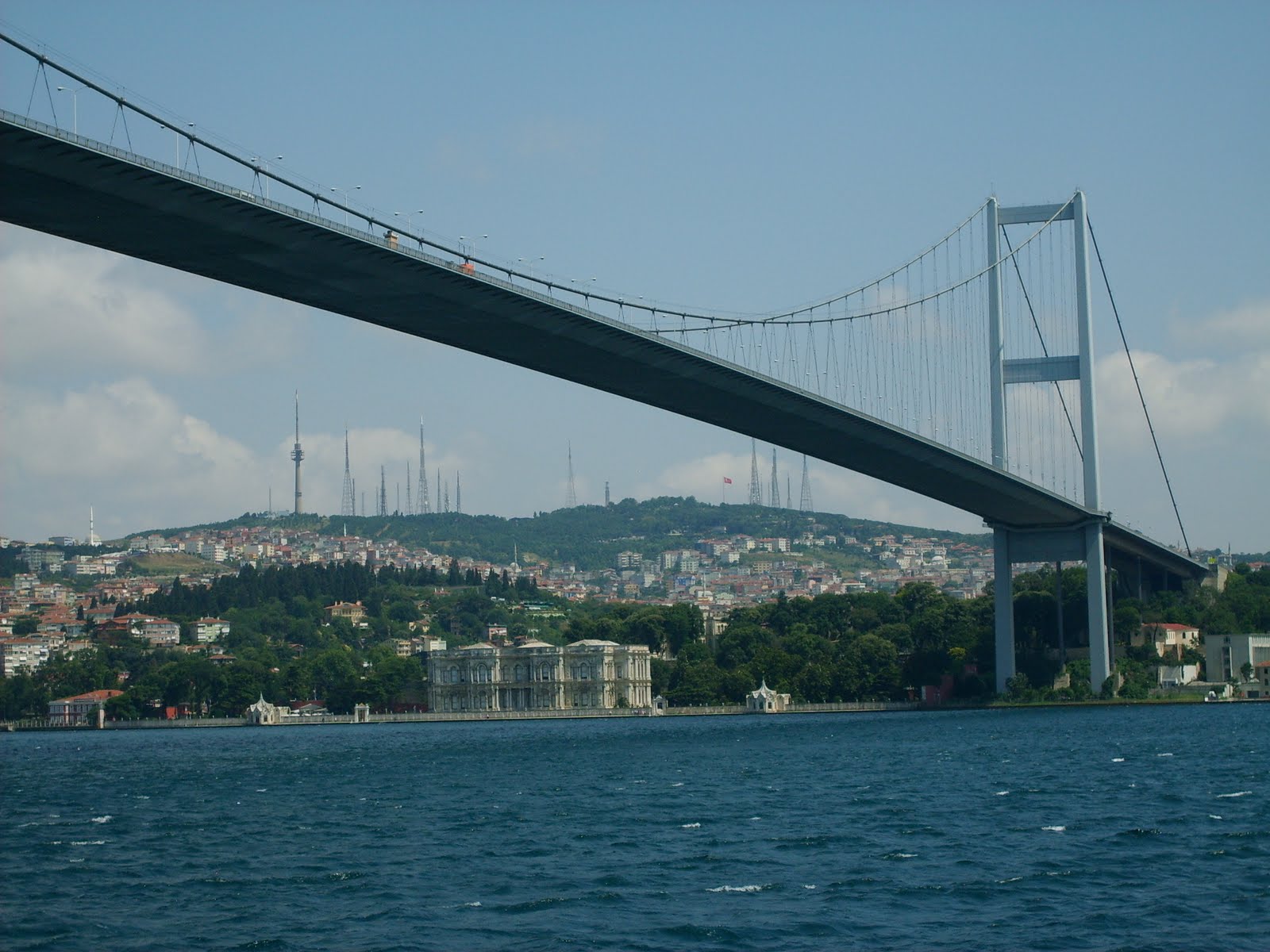
To end my second long day of travels, I decided against a rather expensive tour of the other major palace built by the Ottoman in the 19th century and instead bought a ticket for a boat tour up the Bosphorus! After a summer where the most water I have seen is that which puddles outside my door after the daily thunder storms, it was nice to get out and have some cool sea air in my face for an hour or so. For the equivalent of about $8 I was able to get passage on a boat that took us up the Bosphorus from Dolmabahce palace, under the Bosphorus bridge, to the Rumeli Hisar, the castle built by Mehmed II to facilitate the conquest of Constantinople. While we didn't disembark to see any of these sights, it was a good opportunity for a quick drive-by tour of a number of places that I otherwise wouldn't have been able to see in my short stay. Next time, though, I would much rather take out one of the many sail boats out on the water that day. Maybe I can talk my friends in Boston into making this the destination for the sailing trip next year instead of Maine.
Subscribe to:
Posts (Atom)