Sunday, July 18, 2010
Yeraltında bir şehri, İhlara Vadisi'nde dolaşmaları, ve çok tuzlu bir göl
Although the citadel and churches carved out of the cliff faces were fully impressive in their own right, our first stop on the second day put them firmly in the back of my mind for a solid hour. The Kaymaklı Underground City is pretty well captured in its name, an extensive series of underground churches, wine cellars, and living areas connected by tunnels carved out of the same soft volcanic stone that ennabled the previous days structures to be built. What was remarkable about these rooms, though, was that they were not just a series of holes dug just beneath the surface, but at times (as we were told by our guide) went as far as five stories underground! I couldn't tell exactly how far down we were, but I know at one point early in our descent we came across an air shaft that went down as far as we could see and had some very cold air rushing up from the bottom. After our previous day of hiking around the rocks in the hot sun I could have stayed in the naturally cool underground city for hours. Unfortunately, this was another one of our guided tours and we felt a bit rushed as we went from room to room bypassing a number of side rooms and other passages. They might have been worried about misplacing one of us down there since we have some pretty adventurous students on the trip and the cell reception isn't the best in an underground rock city.
After this part of the tour ended we piled back on the bus and headed to our next stop, a hike through the Ihlara Valley. Although it has pretty stiff competition, this might have been my favorite part of the weekend. The Ihlara valley is another national park area that features a wooded area with a small river running through the middle and a number of hiking paths leading to more Byzantine churches carved out of the stone cliffs. It's basically like a number of areas in Northern California but with the addition of centuries old Byzantine churches and biblical frescoes. Possibly what made this the best part of the trip was that, after feeling rushed through several of the previous parts of the trip, I was able to break off from the group with a few like-minded friends and thoroughly explore every church and side-trail that we came across. The frescoes were amazing and still featured brightly-colored renditions of Jesus and other biblical figures around their walls and the domes carved into the interior of the mountainsides. Once we reached the end of the trail we were treated to lunch at a little cafe that was built on a series of platforms in the middle of the river (well, stream really). Though the food wasn't quite up to the standard set by the rest of Turkish cuisine, I guess you can get away with more when you have such a beautiful setting to serve it in.
After two days of activity and a sizeable lunch, a number of us were almost asleep before we even got back on the bus for the trip back. However, there was one more quick stop on the way back to Ankara, the Tuz Gölü, or Salt Lake. I don't know what it is about breakaway religious groups and salt lakes, but it appears they go hand in hand around the world. This was my first experience wading into one, though, and I think I'm ready to leave it at one. The lake is basically just regular water sitting on a bunch of broken up salt. It's like wading into a lake built on sharp broken rocks that then sting your wounds. That's maybe a bit dramatic since it never actually broke skin, but the effect was not a comfortable one. The sight of the white salt floor with the clear water was beautiful and made for some great pictures, but I was still ready to get back in the bus and make my way back to Ankara after a few minutes. Overall, the weekend was a lot of fun and featured a variety of different activities that in hindsight feel like they had to have taken place over several weekends. Now we are heading into our penultimate week of classes and getting ready for our next big weekend trip to Konya to visit the tomb of Mevlana Jelaleddin Rumi, the famous Sufi and founder of the Mevlevi order. It promises to be another great trip and a strong end to the program.
Saturday, July 17, 2010
Kappadokya'da bir haftasonu
Our first full weekend trip of the summer came a bit later this year, but it was definitely worth the wait. We left early friday afternoon for a weekend in Cappadocia, the region to the east of Ankara that is known for its interesting volcanic rock formations and for the settlements that various people like the Byzantines have carved out of those rocky cliffs over time. While this part of the country's history is moving a bit outside of my comfort zone, the guidebook says that the churches and monasteries that are the main tourist draw date largely from the 9th century on and functioned as a refuge from persecution for their various inhabitants. I can't recount everything we saw since the guides had a very busy itinerary planned, but I will try to give a quick guided tour of the highlights.
After a relaxing friday night in the hotel room we started our saturday at the Göreme Open-Air Museum that features some of the best extant examples of the churches and monasteries that dot the regions cliffs. While this type of thing wasn't entirely new to me after my visit to Petra in Jordan a few years back, I was surprised by how intricate some of the constructions and their decorative frescoes were. Little did I know I was in for a much bigger surprise the next day, but more on that in a bit. The area featured a couple paved pathways leading to examples of the monks' cells and churches with preserved Byzantine frescoes of various saints and biblical figures. These were impressive enough and I assumed they would be some of the best we would see all weekend, but I was amazed that at each place we stopped the sights seemed to get more and more impressive. After the open air museum we drove back up the hill towards the Üç Hisar Kalesi, the mound of rock featured in pictures two and three, that has functioned as a citadel for the region's inhabitants through many centuries and that offers a pretty amazing view of the surrounding countryside. Some of the most distinctive features of this countryside are the Peri Bacaları, or Fairy Chimneys, that were formed when some of the softer material in the region eroded and left the harder portions of volcanic rock as they are seen now (in picture 4).
Some of the more fun portions of the day occurred when the guides let us off the leash and allowed us to hike around these formations and explore the area a bit. Of course, these parts of the day were also broken up by visits to local jewelry and pottery shops where some very interesting exhibitions of how their wares are made were inevitably followed by an offer to let us tour their show rooms where we could purchase the products for very reasonable prices! The prices were a bit better for the pottery than for the jewelry so Amanda and I are now the proud owners of a decorative ceramic tile with some Quranic calligraphy for our new apartment wall. The afternoon was capped off with a visit to a local winery's salesroom and an impromptu game of soccer in the abandoned lot across the street that is probably the only time I have (or will) play soccer with a series of tied-up growling attack dogs marking the boundaries of the field. It was only after we finished that I saw the sign saying "Private Property, Keep Out"! By this time it was pretty late, but before we headed back to the hotel we were taken further up into the hills for a view of what we were told was the best view of the sunset in the region. Again, it was pretty similar to the sunset that I saw in Petra, which is no small thing to say. However, this sunset wasn't followed by the confiscation of my passport and an hour of questioning by the Jordanian police, so I can safely say it wins out overall!
Our evening wrapped up with another visit to the all-you-can-eat buffet at the hotel and some group bonding over drinks in our hotel rooms. If for no other reason than this, I wish the trip had happened earlier because it was good to get a chance to spend time with the other students in a less formal setting than we normally have. Luckily we were still able to get a little rest for our second action-packed day of tours.
Thursday, July 15, 2010
Türk Kızılay Derneği - Turkish Red Crescent Society Headquarters
Even though I've fallen off a bit in updating this for our weekday excursions and I typically don't do any updates without pictures I had to make an exception for our trip today. We were given the chance to take a guided tour of the headquarters of Türk Kızılayı, the Turkish Red Crescent Society, which is the local branch of the Islamic equivalent of the Red Cross that operates in a number of countries throughout the world. Though I didn't know what to expect going into the trip, it turns out we were granted entrance to the large compound by the airport that serves as their national headquarters and given a guided tour of their operations! After some conversation and tea (of course!) in the disaster response area we were shown around to the other buildings to see some examples of the temporary housing and tents they use, the factory where they construct the tents, and the local archives dating back to the late 19th century. According to our guide they can put up the temporary housing units in about four minutes a piece and from the ones we saw they can fit a pretty good number of people without being too crowded. Türk Kızılayı has been involved in disaster responses not only in Turkey and elsewhere in the region, like Gaza, but also for the Tsunami in Indonesia and the recent earthquake in Haiti. Maybe the best thing about the trip is that it is one of the few times that I have visited an organization like this and come away thinking that I wish there was some way for me really get involved in their work. Though a classmate and I joked that going to work with them on water treatment in Gaza did sound like more fun than grad school, I think it was mostly hypothetical! Nevertheless, it does seem like an organization where someone could put some knowledge of English, Arabic, and Turkish to good use so I will keep it in the back of my mind. If nothing else, I was able to exchange information with the archivist which could be a very good resource in the not too distant future. All in all, this was probably one of the best weekday trips of the summer and something the program should try to do much more of in the future!
[Cultural lesson of the week: After the trip to the Red Crescent Society and a few rounds of beer and nargileh with friends, I returned home to find my family watching the Turkish version of Wheel of Fortune. Although the basic game is the same, in Turkey it goes on for nearly two hours and, rather than featuring audience members as the main contestants, it has a rotating cast of characters that not only spin the wheel and guess the puzzles, but also break into song and dance numbers at seemingly random points in the game! In addition to the odder aspects of the show, they still feature some participation from regular people, often via satellite in various small villages throughout the country. The oddities of the professional players are made up for by these people that would probably never make it past the producers of the American version. I saw an elderly woman in one of the villages win a house on the game tonight and I'm not sure I've ever seen anyone so happy! I couldn't quite make it through the whole two hours but it was still fun to watch! Now if only they had a local version of Who Wants to Be a Millionaire like they did in Damascus. There's nothing like building your language skills and your random trivia at the same time!]
[Cultural lesson of the week: After the trip to the Red Crescent Society and a few rounds of beer and nargileh with friends, I returned home to find my family watching the Turkish version of Wheel of Fortune. Although the basic game is the same, in Turkey it goes on for nearly two hours and, rather than featuring audience members as the main contestants, it has a rotating cast of characters that not only spin the wheel and guess the puzzles, but also break into song and dance numbers at seemingly random points in the game! In addition to the odder aspects of the show, they still feature some participation from regular people, often via satellite in various small villages throughout the country. The oddities of the professional players are made up for by these people that would probably never make it past the producers of the American version. I saw an elderly woman in one of the villages win a house on the game tonight and I'm not sure I've ever seen anyone so happy! I couldn't quite make it through the whole two hours but it was still fun to watch! Now if only they had a local version of Who Wants to Be a Millionaire like they did in Damascus. There's nothing like building your language skills and your random trivia at the same time!]
Saturday, July 10, 2010
Safranbolu
After a busy weekend in Istanbul and another jam-packed week of classes and cultural activities, I decided to spend the next free weekend with as much solitary relaxation as possible. I booked a ticket to Safronbolu, a UNESCO world heritage site that is known for featuring a well-restored Ottoman trading town. While the description made it sound very similar to our previous trip to Beypazarı, this trip had two things the previous one didn't: A) this town was hundreds of miles from almost anyone else that I knew (I will explain the almost in a second); and B) this time I had a hotel room that I could comfortably live in for the rest of my life. While I really enjoy spending time with my fellow students and my host family, after about five weeks of spending time with everyone I was ready to just get on a bus and not recognize anyone for a couple days. Also, as I learned last year with my post-program bus ride to Antalya, not having that crutch of being able to communicate in English can be very good for your Turkish. As it turns out my classmate Jordan (or Cordin as we spell it in Turkish) was also in town, but this made for the perfect mix of solitary travel/sightseeing and evening companionship.
After a few hours on the bus and a short taxi ride I arrived in the middle of the old town. I found my hotel pretty quickly and decided to drop my things off before exploring the town a bit. After seeing my room I'm still amazed I left again before they dragged me out for nonpayment. For the equivalent of about $45 I was able to book my own room in an old Ottoman house that has been converted to a pensiyon. Going into it I was just thankful that they assured me I would have my own bathroom, a luxury that is not guaranteed in every discount hotel. As it turns out, I also had a queen sized bed, two walls of couches, satellite TV (including reruns of Chuck with Turkish subtitles!) and a great view of the garden beneath my window. When the proprietor asked if the room was okay it was hard to keep from laughing! Despite the nice accomodations, I settled in a bit and then went off to explore the town. My shoes were still recovering from the three straight days of walking in Istanbul the previous weekend so I was thankful that this time there was a little less to do. So little, in fact, that I felt no pressure to start right away and I decided to have a leisurely lunch of homemade Mantı (like little tortellini bathed in yogurt and tomato sauce) and then go experiment with my first Turkish haircut. After a momentary (and perhaps ill-advised) moment of bravery that morning I had decided to get rid of my excess hair in dramatic fashion and just have my head shaved. You will all be happy to hear that my barber had better sense and responded to this request with a slightly concerned "Emin misin? (Are you sure?). To be fair, the whole conversation was in Turkish and my grasp of the language is still not perfect so I could just as easily have asked him to shave a Turkish flag into my head and I wouldn't really know it. However, after a little conversation ranging from how I really wanted my hair cut, to why I was in Turkey, to what I studied, to whether I was married, to whether I had children (the inevitable follow up question), to what I thought of Obama, we finally got back around to the hair and he told me "I'm just going to give you the American cut." It all seems so simple in hindsight, and rather lucky that the American cut is exactly the cut I get all the time! Apparently it's rather appropriately named. After getting over the initial fear of trying to negotiate my hair style in a foreign language I was very glad that I bit the bullet and gave it a try. The barber was about my age (maybe a bit younger) and I was able to carry on a pretty fun conversation with him for about 40 minutes while he took care of my hair. Plus, unlike when I get my hair cut in the US the conversation was actually pretty interesting and I can't think of a single time in the US when my barber brought me a cold soda and then stopped for a cigarette and some conversation in the middle of the haircut! All in all, it was a great experience (despite the four unsolicited spritzes of cologne on my shirt as he was finishing) and my hair turned out just like I wanted it to!
After the haircut I got back out to exploring the town before nightfall. Although I can see parallels between Safranbolu and Beypazarı with its old Ottoman houses and mosques, the one thing that puts Safranbolu over the top is the large Caravanserai in the middle of town. It's now a luxury hotel, putting it well out of my price range, but I was still able to wander into the courtyard and up a staircase to get a nice photo opportunity from the roof area. After a paper I did last Fall on caravanserais it was great to see one so perfectly restored. Granted, the dance floor and stereo system were not exactly authentic, but they were setting it up for a wedding later that night so some things can be forgiven. The town also features a number of old mosques and a great handicrafts market that made for hours of fun exploration. I rounded out the night by talking to Amanda on skype (at which point she spoiled the surprise of my anniversary present - iPhone 4!) and then hanging out in my hotel room for a bit before meeting up with Jordan for dinner and a couple beers. The next day was fairly uneventful in comparison to the first since all I really did was make my way up to the lookout spot above the town and then tour one of the old Ottoman houses. Proving how small the town is, I actually ran into Jordan on the way out of the Ottoman house and we ended up relaxing and having tea for the rest of the day until we could catch our bus ride home. Despite a much smaller town and a more relaxed schedule, this weekend trip was right up there with Istanbul in terms of enjoyability. And if you're ever in the area, definitely check out the Bostancı Pensiyon. It's worth every kuruş!
Sunday, July 4, 2010
Bosphorus Tour
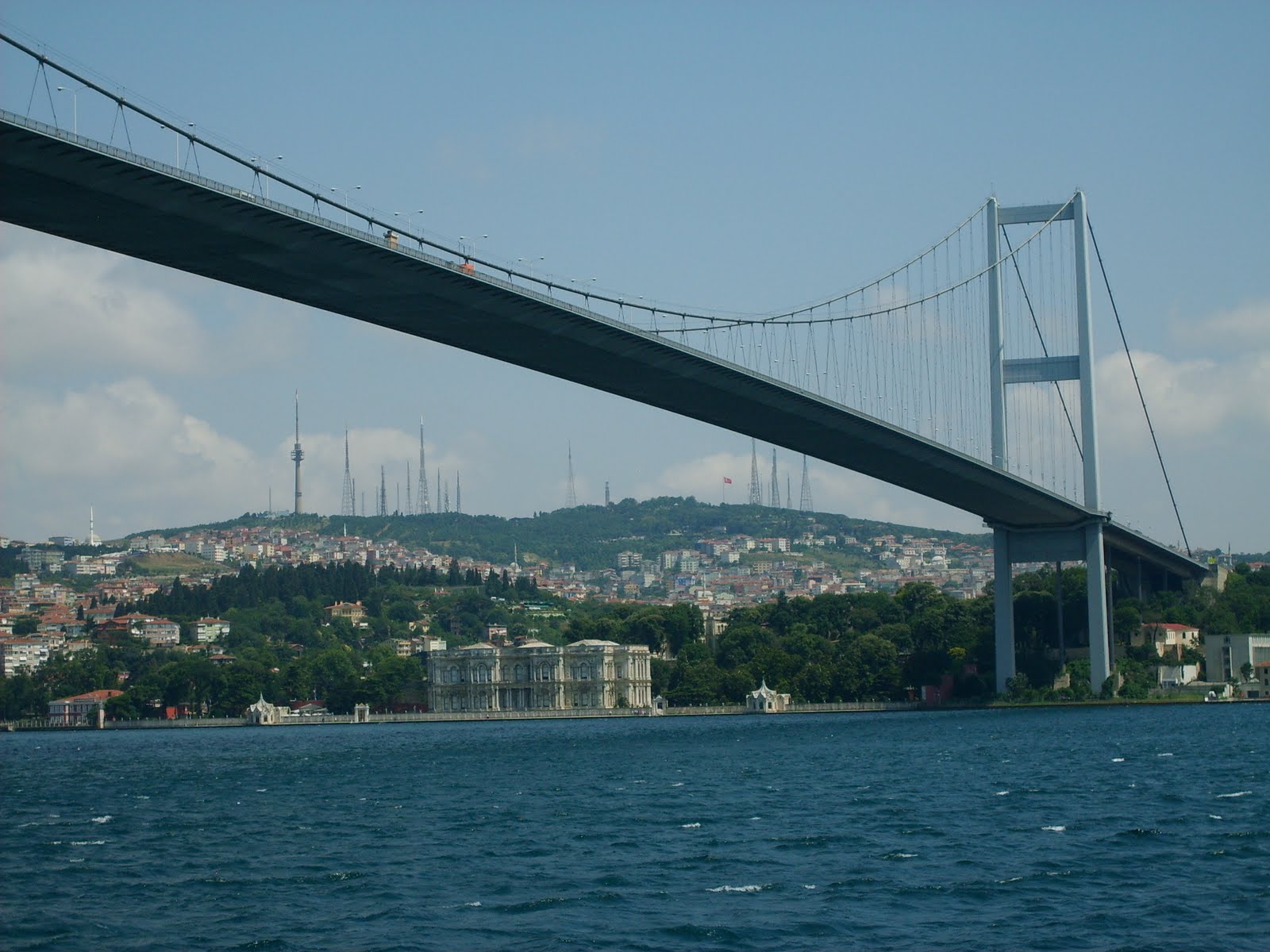
To end my second long day of travels, I decided against a rather expensive tour of the other major palace built by the Ottoman in the 19th century and instead bought a ticket for a boat tour up the Bosphorus! After a summer where the most water I have seen is that which puddles outside my door after the daily thunder storms, it was nice to get out and have some cool sea air in my face for an hour or so. For the equivalent of about $8 I was able to get passage on a boat that took us up the Bosphorus from Dolmabahce palace, under the Bosphorus bridge, to the Rumeli Hisar, the castle built by Mehmed II to facilitate the conquest of Constantinople. While we didn't disembark to see any of these sights, it was a good opportunity for a quick drive-by tour of a number of places that I otherwise wouldn't have been able to see in my short stay. Next time, though, I would much rather take out one of the many sail boats out on the water that day. Maybe I can talk my friends in Boston into making this the destination for the sailing trip next year instead of Maine.
Subscribe to:
Posts (Atom)